


Feeding off-world crews on hydrogen: an SSHD review of bacterial protein platforms
When most people picture food production on the Moon or on Mars, the mental image is a row of green photobioreactors — Chlorella or Spirulina turning sunlight into edible biomass. Microalgae have, after all, been the workhorse of closed-life-support research for half a century, and Japan retains world-class capability in their cultivation. They are also one of the most cost-efficient ways humanity has ever found to produce protein under abundant tropical sunshine. But the off-world food problem is not only about cost per kilogram on Earth. Once the operating environment is included in the equation — light, electricity, volume, geometry, distance from the sun — a structurally different class of microorganisms enters the conversation: hydrogen-oxidizing bacteria, or HOB. They do not need light. They eat hydrogen. And our review treats them not as a replacement for microalgae, but as a complementary platform that becomes attractive in a different operating envelope.
Space Seed Holdings, Inc. (SSHD), a Tokyo-based deep-tech venture builder focused on space, has completed an internal comparative review of the technology and the industry around HOB-based protein production, drawing on more than twenty publicly available sources — peer-reviewed papers, granted and published patents, and disclosures from the four main companies in the field. The review was conducted as part of SSHD’s ongoing assessment for SPACE LAB., a research-utilization business that the company will formally launch in March 2026. SSHD’s leadership also directs the algal-resource upcycling team at the RIKEN TRIP Bio-Zero-emission Project, and our review accordingly treats microalgae and HOB as complementary tools — each with its own operating envelope — rather than as competing benchmarks. The summary below is a public-facing distillation of that work.
What SSHD reviewed, and how
SSHD researchers compiled and read approximately twenty primary sources, including the 2016 Liu et al. paper in Science on a hybrid water-splitting biosynthetic system [1], the 2020 review by Pander et al. in Engineering Biology [2], the 2025 Nutrition Bulletin review by Watson et al. [3], and the public technical disclosures of Solar Foods (Finland), Aerbio (UK / Netherlands), Air Protein (USA) and CO2 Utilization Institute (Japan). Patent filings of these four companies were screened on Google Patents at the family level; clause-level analysis was deferred to a separate workstream. This article is a narrative synthesis. No proprietary SSHD experimental data and no unpublished partner information are included.
How HOB actually work
HOB are chemolithoautotrophs. They obtain energy from the Knallgas reaction — the controlled oxidation of molecular hydrogen with oxygen — and use that energy to fix carbon dioxide into biomass. The best-studied example is Cupriavidus necator (formerly Ralstonia eutropha), a soil bacterium that grows on H2, O2 and CO2 and accumulates protein up to roughly 70 % of dry weight, with an amino-acid profile closer to animal protein than to plant protein [2].
Mechanistically, the cell carries [NiFe]-hydrogenases that strip electrons from H2. Some of those electrons enter the respiratory chain to make ATP; others reduce NAD+ to NADH. ATP and NADH are then poured into the Calvin-Benson-Bassham (CBB) cycle — the same CO2-fixing cycle that green plants and microalgae use, with the same key enzyme, RubisCO. In other words, C. necator and the algae in any university lab share an identical “downstream” carbon-fixation chemistry; they differ only in how reducing power is generated. Algae use photons; HOB use hydrogen (see Fig. 1).
Figure 1. From electricity to protein: two pathways into the same Calvin-Benson-Bassham cycle.
Microalgae (top) and HOB (bottom) feed the same CBB cycle from different energy inlets. The downstream chemistry that turns fixed carbon into protein and other biomass is shared. Schematic prepared by SSHD researchers.
It is worth noting, however, that not every HOB uses CBB. Hydrogenobacter thermophilus, a thermophile isolated from Japanese hot springs, fixes CO2 through the reductive tricarboxylic-acid (rTCA) cycle, which costs less ATP per CO2 than CBB and is thought to resemble an ancient form of carbon metabolism [4]. Some related anaerobic acetogens such as Acetobacterium woodii use the Wood-Ljungdahl pathway, the most energy-efficient CO2-fixation route known [5]. For industrial protein production, however, the field has converged on CBB-using species: oxygen tolerance and growth rate matter more than ATP efficiency once the process is scaled.
Two operating envelopes, not a horse race
It is tempting to settle the question with a single efficiency number. We resist that temptation, and we ask readers to do the same. The two platforms run on different physics, and any number is only meaningful inside a specified operating context.
For microalgae, the relevant numbers are well known. Under ideal laboratory conditions, microalgae can convert roughly 9–12 % of incident light energy into chemical energy in biomass on theoretical grounds; under outdoor open-pond conditions, the realised figure typically falls to about 0.5–1 % because of light saturation, self-shading, weather variability and harvesting losses [6]. Critically, those outdoor losses are paired with extremely low capital intensity: open ponds, raceway systems and tropical sunshine are inexpensive on a per-kilogram basis, and microalgae have a long, regulator-trusted track record as food and feed. Under outdoor sun-belt conditions at scale, microalgae remain unmatched on capital cost and on regulatory familiarity.
For HOB, the relevant numbers describe an electrochemical chain rather than a photochemical one. The 2016 Liu et al. study showed that a hybrid system pairing a cobalt-phosphorus water-splitting catalyst with C. necator fixed CO2 with a CO2-reduction energy efficiency of roughly 50 %, equivalent to about 180 grams of CO2 per kilowatt-hour of electricity, and reported a solar-to-chemical efficiency of about 8 % when paired with a photovoltaic source [1]. Solar Foods, the Finnish pioneer that built the world’s first commercial gas-fermentation food factory in Vantaa, expresses the same kind of figure in operational terms — 18–30 kWh of renewable electricity per kilogram of biomass, which the company describes as roughly 20 % electricity-to-calorie efficiency and, by its own reckoning, “20 times higher than natural photosynthesis” [7][8]. That last comparison is Solar Foods’ own framing of its process; SSHD does not adopt it as an evaluative axis. Stacking the chain — a 22 %-efficient PV panel, ~65 %-efficient electrolysis, ~20 % electricity-to-biomass — yields an integrated solar-to-biomass figure on the order of a few percent, with wide error bars.
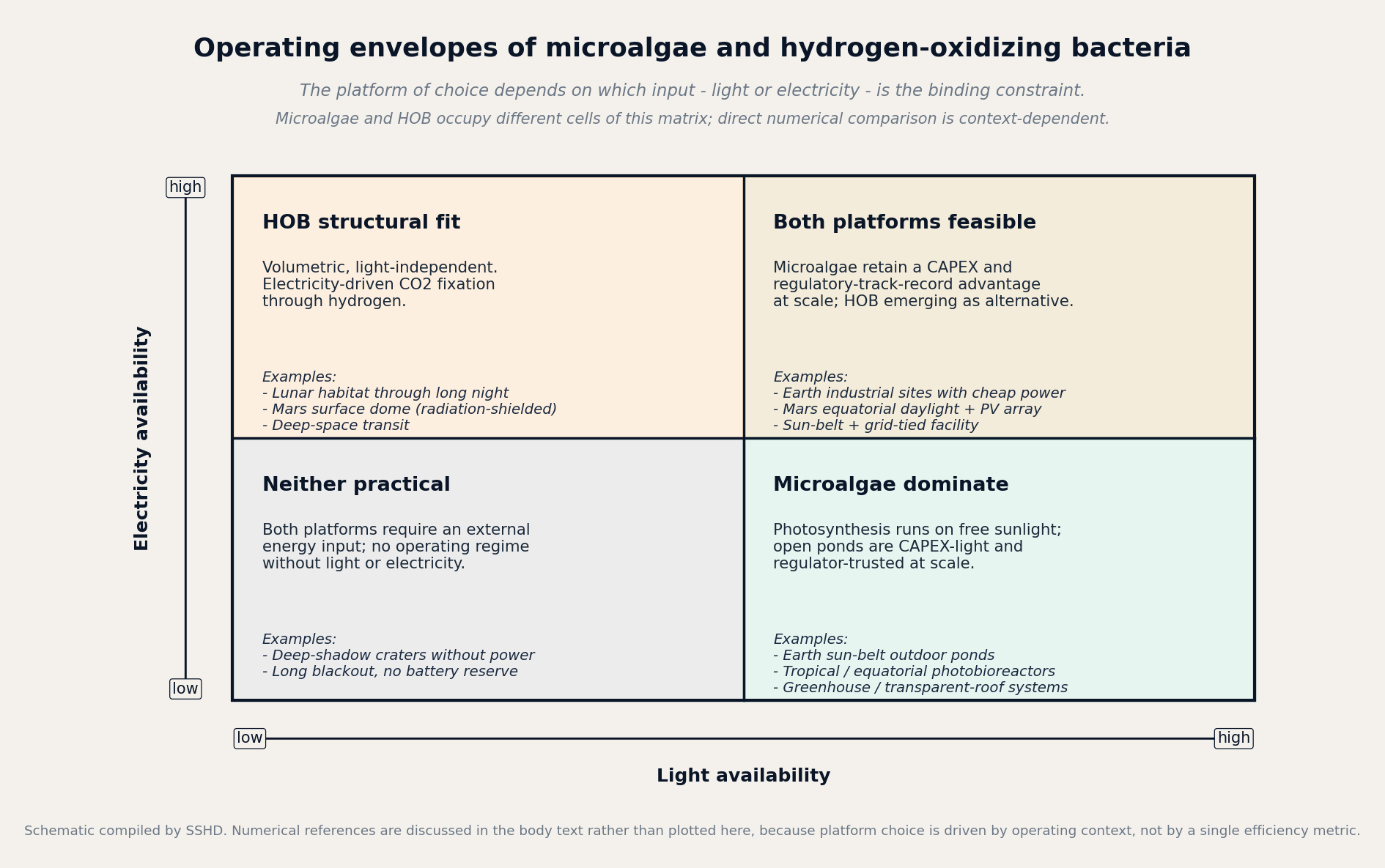
The honest conclusion is not that one platform is “X times better” than the other. It is that microalgae and HOB sit in different cells of an operating-envelope matrix (see Fig. 2). Where light is abundant and electricity is expensive — outdoor sun-belt agriculture being the canonical case — microalgae have the structural advantage. Where electricity is abundant and light is constrained — a lunar habitat through the long night, the inside of a planetary-surface dome shielded against radiation, deep-space transit — the chain that runs through hydrogen has structural advantages: no light requirement, volumetric rather than areal scaling, fast doubling times, and direct compatibility with electrolysers driven by nuclear or stored solar electricity.
Figure 2. Operating envelopes of microalgae and hydrogen-oxidizing bacteria.
Operating-envelope matrix for protein-producing platforms. The horizontal axis is light availability; the vertical axis is electricity availability. Microalgae and HOB occupy different cells of this matrix; in any given off-world or terrestrial context the platform of choice depends on which of the two inputs is the binding constraint. Compiled by SSHD.
In short, the two platforms are complementary, not substitutive. SSHD’s review is therefore not a search for a single winner; it is an attempt to map which platform fits which environment, and to track the technology, intellectual property and industrial readiness of each.
The industrial landscape
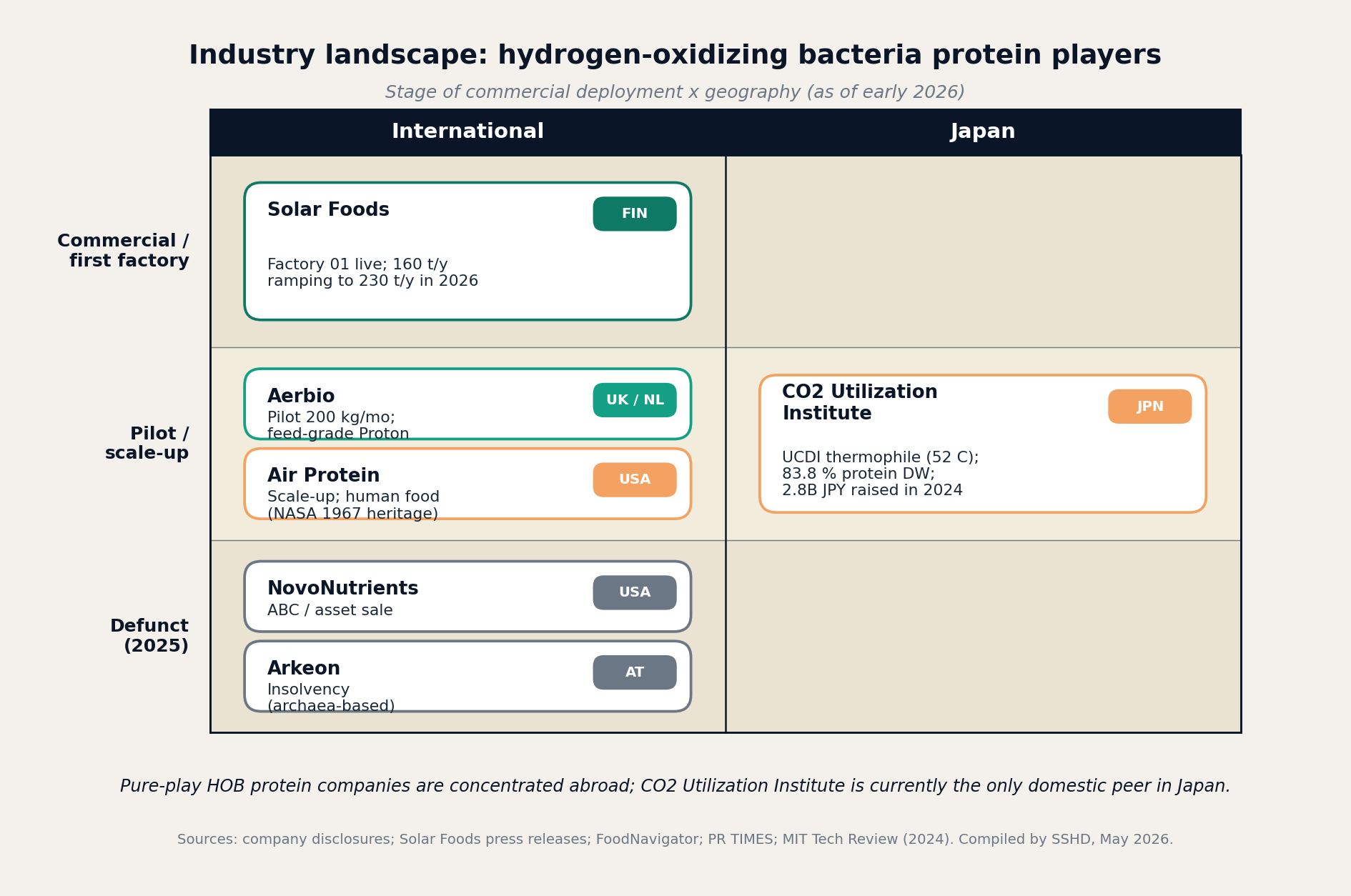
A handful of companies have pushed HOB protein from concept to product (see Fig. 3).
Figure 3. Industry landscape: HOB protein players, by stage and geography.
Stage of commercial deployment by geography, as of early 2026. Sources: company disclosures, Solar Foods press releases, FoodNavigator, PR TIMES, MIT Technology Review.
Solar Foods opened Factory 01 in Vantaa in April 2024 and reached its 160-tons-per-year design capacity, with a planned ramp to 230 tons in 2026 and a Factory 02 targeting 6,400 tons annually [9]. Its product, Solein, is approved for sale in Singapore and is moving through novel-food review in the United States and the European Union; in April 2026 the company secured a US patent on its core process [10]. Aerbio, the rebranded entity that emerged from the United Kingdom’s Deep Branch Biotechnology, runs a pilot plant at Brightlands Chemelot in the Netherlands producing about 200 kg per month of “Proton,” a feed-grade single-cell protein for salmon and chickens [11]. Air Protein in California, a spinoff of Kiverdi, traces its lineage directly to NASA’s 1967 closed-life-support concept paper [12], and is developing plant-based and cultivated-meat-style consumer products.
Not every player has cleared the scale-up valley. Both NovoNutrients in California and Arkeon Biotechnologies in Austria entered insolvency proceedings in 2025 [13]. SSHD reads this as a market signal that gas fermentation, while elegant on paper, demands cheap hydrogen, capital-efficient bioreactors and patient regulatory navigation; surviving operators have leaned heavily on regulatory approval and partnership strategy rather than purely on bioprocess novelty.
In Japan, the field is still nascent but not empty. CO2 Utilization Institute (CO2資源化研究所), based in Kawasaki, raised approximately 2.8 billion yen in 2024 to scale its proprietary thermophilic UCDI® hydrogen bacterium, which the company reports as having a crude protein content of 83.8 % — among the highest in the field — and an optimal growth temperature of 52 °C, which is helpful for contamination control [14]. To SSHD’s knowledge, it is at present the only domestic pure-play HOB protein company.
Why this matters for space
Closed-loop life-support architectures for the Moon and Mars have so far leaned on cyanobacteria. The European Space Agency’s MELiSSA loop uses Spirulina in one of its compartments [15]; the Japan Aerospace Exploration Agency’s CEEF facility in Aomori has pursued plant- and animal-based loops with incineration-based CO2 recovery; NASA’s 1967 closed-life-support paper, which originated the modern interest in hydrogenotrophic food [12], has only intermittently been revisited since. SSHD’s reading is that future architectures are unlikely to converge on a single workhorse. Microalgae remain attractive wherever sunlight can be delivered cheaply to a thin reactor — for example, in a transparent-roof greenhouse on a sun-facing surface, or in a sun-belt outdoor pond on Earth that supports the broader feedstock economy. HOB become attractive in the complementary regime: where electricity is plentiful (from a nuclear reactor, a large photovoltaic array, or eventually space-based solar power) but light is hard to deliver into a thick, radiation-shielded volume. HOB also bring secondary advantages that matter under cargo-scarce off-world conditions: very fast doubling times of two to four hours, volumetric rather than areal scaling, and the ability to accumulate polyhydroxybutyrate, a biodegradable polymer with potential as feedstock for in-situ manufacturing.
Caveats
SSHD researchers stress three caveats. First, the environmental advantage of HOB only holds with low-carbon electricity; running gas fermentation on fossil power inverts the climate case. Second, safety engineering is non-trivial: hydrogen is flammable across a 4–75 % range in air, and reactor design, regulatory compliance and crew protection in space environments will demand serious capital. Third, unit economics remain unproven at scale — the 2025 insolvencies of NovoNutrients and Arkeon are reminders that even technically successful platforms can run aground on hydrogen cost, capex and pricing.
About SSHD
Space Seed Holdings, Inc. (SSHD) is a Tokyo-based deep-tech venture builder positioned at the intersection of space and biology, with three thematic verticals: space × fermentation, space × medicine, and space × aquaculture (a fully resource-circular, high-efficiency food-supply vision). The company is led by Kengo Suzuki, co-founder and former CTO of euglena Co., Ltd. Suzuki also serves as Team Director of the Algal-Resource Upcycling Research Team at the RIKEN TRIP Bio-Zero-emission Project (TRIP-BZP), the position from which SSHD maintains direct visibility into both photosynthetic and chemoautotrophic platforms. SSHD’s research-utilization business, SPACE LAB., launches in March 2026 and is evaluating hydrogen-oxidizing bacteria as one candidate platform — alongside microalgae and other fermentation systems — for off-world food architectures. The company’s longer-term goal is to assemble, by 2040, the technology stack required for sustained human habitation in space.
Acknowledgements
The authors thank members of SPACE FOODSPHERE for sharing partial information and providing input that informed this review. The interpretations and conclusions presented here are those of Space Seed Holdings, and any remaining errors are our own.
References
[1] Liu, C. et al. (2016) “Water splitting–biosynthetic system with CO2 reduction efficiencies exceeding photosynthesis.” Science 352:1210–1213. https://www.science.org/doi/10.1126/science.aaf5039 [2] Pander, B. et al. (2020) “Hydrogen oxidising bacteria for production of single-cell protein and other food and feed ingredients.” Engineering Biology. https://pmc.ncbi.nlm.nih.gov/articles/PMC9996702/ [3] Watson, A. et al. (2025) “Microbial protein for human consumption: towards sustainable protein production.” Nutrition Bulletin. https://onlinelibrary.wiley.com/doi/10.1111/nbu.70028 [4] Shiba, H. et al. on the rTCA cycle in Hydrogenobacter thermophilus. https://link.springer.com/article/10.1007/BF00408058 [5] Ragsdale, S. W. & Pierce, E. (2008) “Acetogenesis and the Wood-Ljungdahl pathway of CO2 fixation.” Biochim. Biophys. Acta. https://pmc.ncbi.nlm.nih.gov/articles/PMC2646786/ [6] Theoretical and outdoor solar-to-biomass efficiency of microalgae. Mar. Biotechnol. https://link.springer.com/article/10.1007/s10126-010-9258-2 [7] Solar Foods science page. https://solarfoods.com/science/ [8] Solein process and energy efficiency overview, PricePlow. https://blog.priceplow.com/supplement-ingredients/solein/microbe-science [9] Solar Foods Factory 01 reaches productivity targets (October 2025). https://solarfoods.com/wp-content/uploads/2025/10/Press-release_Solar-Foods-Factory-01-has-reached-its-productivity-targets.pdf [10] Solar Foods US patent for Solein, NutraIngredients (April 2026). https://www.nutraingredients.com/Article/2026/04/16/solar-foods-wins-us-patent-for-air-protein-solein/ [11] Aerbio pilot facility, FoodNavigator (August 2024). https://www.foodnavigator.com/Article/2024/08/28/aerbio-launches-gas-to-feed-pilot-facility/ [12] NASA 1967 closed life-support report. https://ntrs.nasa.gov/api/citations/19670025254/downloads/19670025254.pdf [13] MIT Technology Review on Solar Foods, NovoNutrients and Air Protein (October 2024). https://www.technologyreview.com/2024/10/21/1105171/air-protein-biotech-solar-foods-novonutrients-alternative-protein/ [14] CO2 Utilization Institute funding round, PR TIMES. https://prtimes.jp/main/html/rd/p/000000007.000045163.html [15] MELiSSA microbial ecology review. https://pubmed.ncbi.nlm.nih.gov/16431089/
Press Contact
Space Seed Holdings, Inc. 2F Hamamatsucho Diamond Building, Minato-ku, Tokyo, Japan Web: https://ss-hd.co.jp/
For press and media inquiries, please contact Space Seed Holdings via the contact form on the company website above. SSHD’s communications office responds to accredited media on the topics covered in this review, including SPACE LAB., the Fermentation and Longevity Fund, and the company’s research-utilization activities.
![Two energy inlets, one CO2-fixation cycle. Microalgae feed the Calvin-Benson-Bassham (CBB) cycle with photosystem-derived NADPH and ATP; hydrogen-oxidizing bacteria (HOB) feed the same cycle with [NiFe]-hydrogenase-derived NADH and ATP. Schematic by SSHD.](https://jptimes.xtdz.top/wp-content/uploads/2026/05/333-image-2.png)