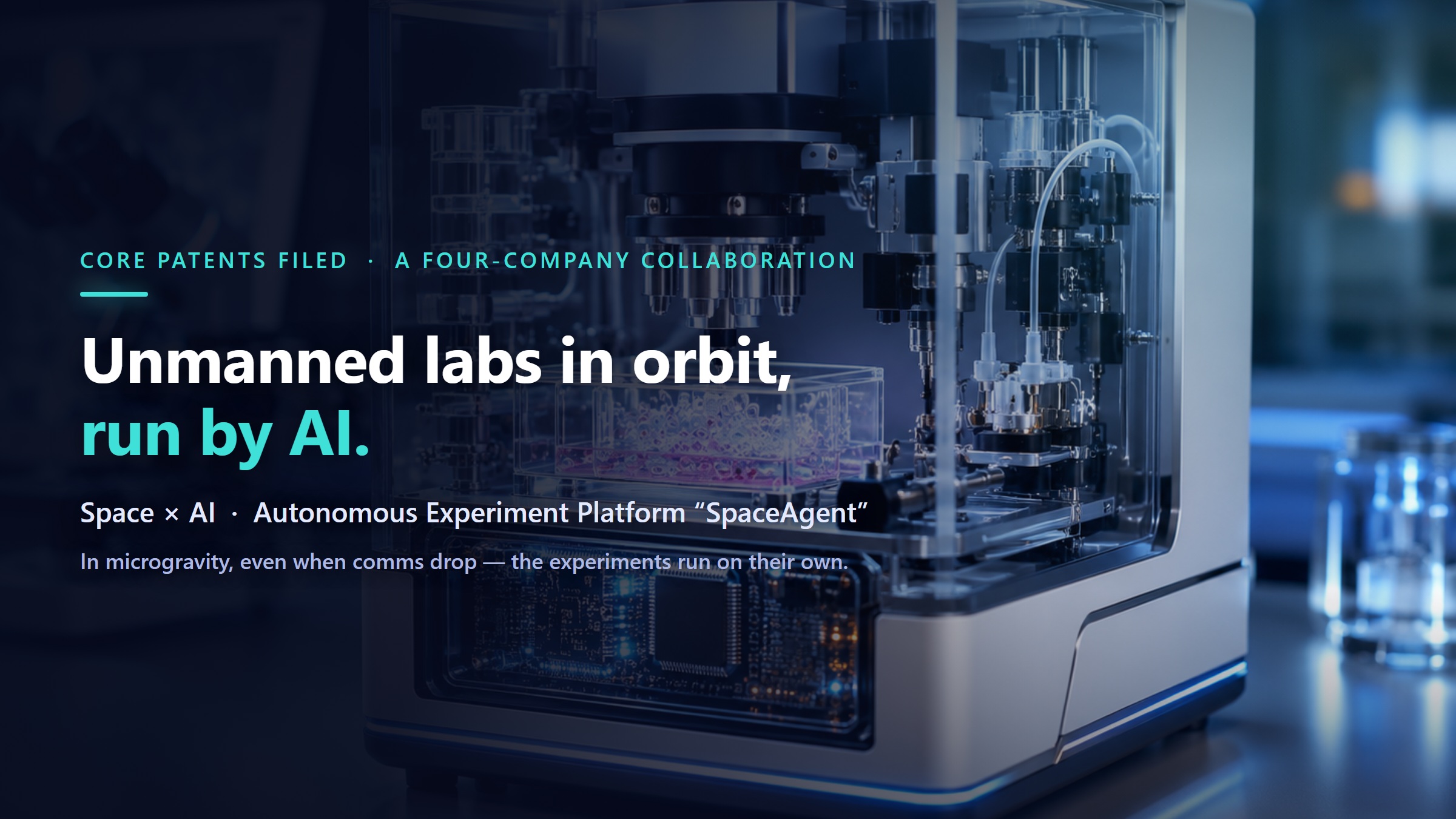



Space Seed Holdings and Three Partners File Core Patents for "SpaceAgent"
TOKYO — Space Seed Holdings Inc. (Minato-ku, Tokyo; Representative Director and CEO: Kengo Suzuki; hereafter “SS-HD”) and three partner companies have filed two foundational patent applications for “SpaceAgent,” an automation platform that runs scientific experiments autonomously in space and on the ground. Filed with the Japan Patent Office on June 10, 2026, the applications comprise a general-purpose invention that orchestrates an entire experiment and an invention specialized for cell-based experiments. Together they aim to support everything from space-biology to materials and drug-discovery research on a single foundation.
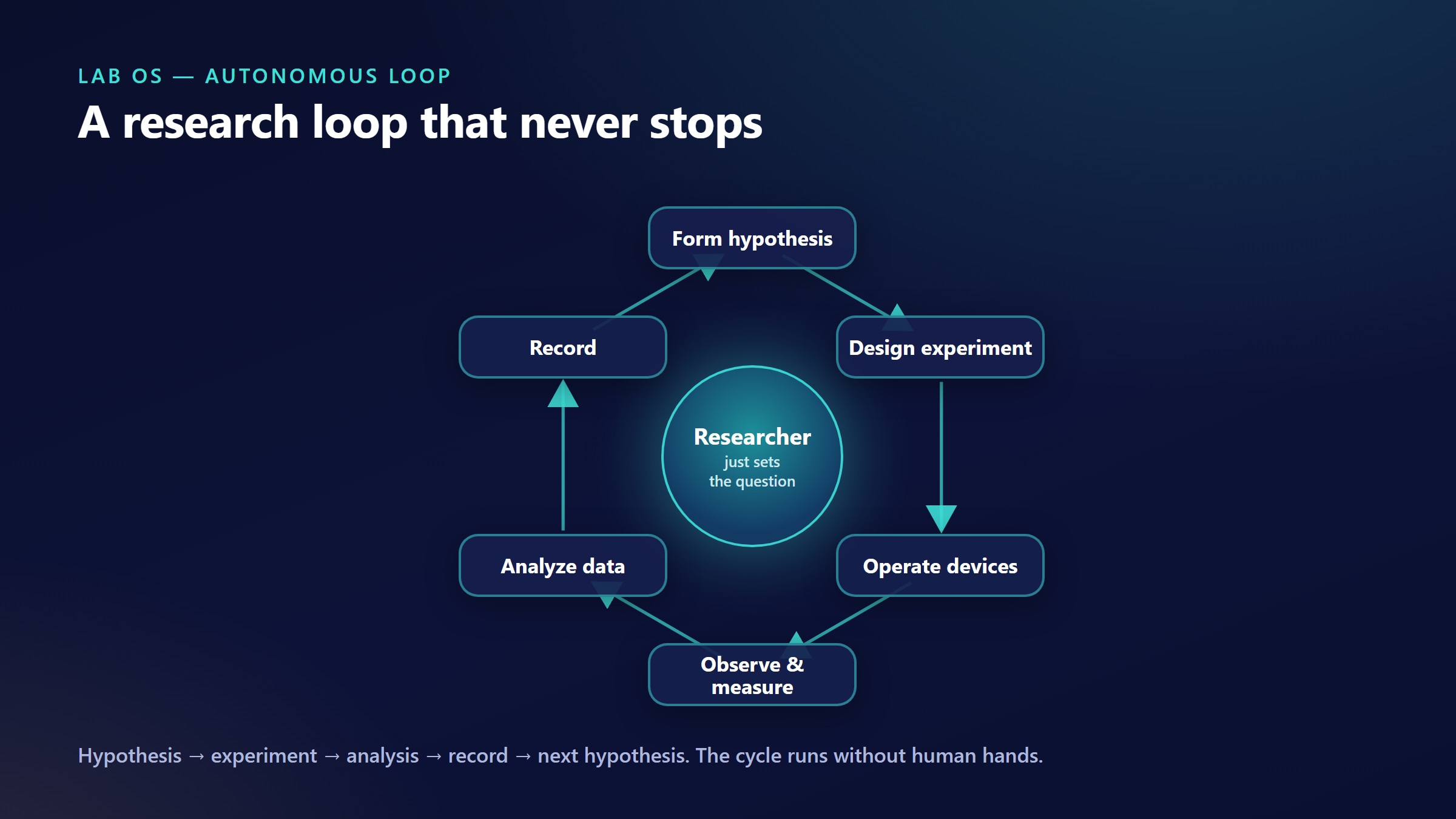
SpaceAgent is built around a simple idea: a researcher gives a question — “what do I want to find out?” — and an AI then runs the full cycle on its own, from designing the experiment and operating the instruments to observation, data analysis, recording, and proposing the next hypothesis to test. It is designed to keep experiments moving on the ground, in orbit where no one can be present, and even during the hours when communication is interrupted.
Why experiments in space are hard
Space is a uniquely valuable place to run experiments. In microgravity, phenomena hidden by gravity on the ground come into view — changes in how cells behave, or proteins and materials forming more ordered crystals — with significant promise for drug discovery and new materials. Yet space brings difficulties that the ground does not.
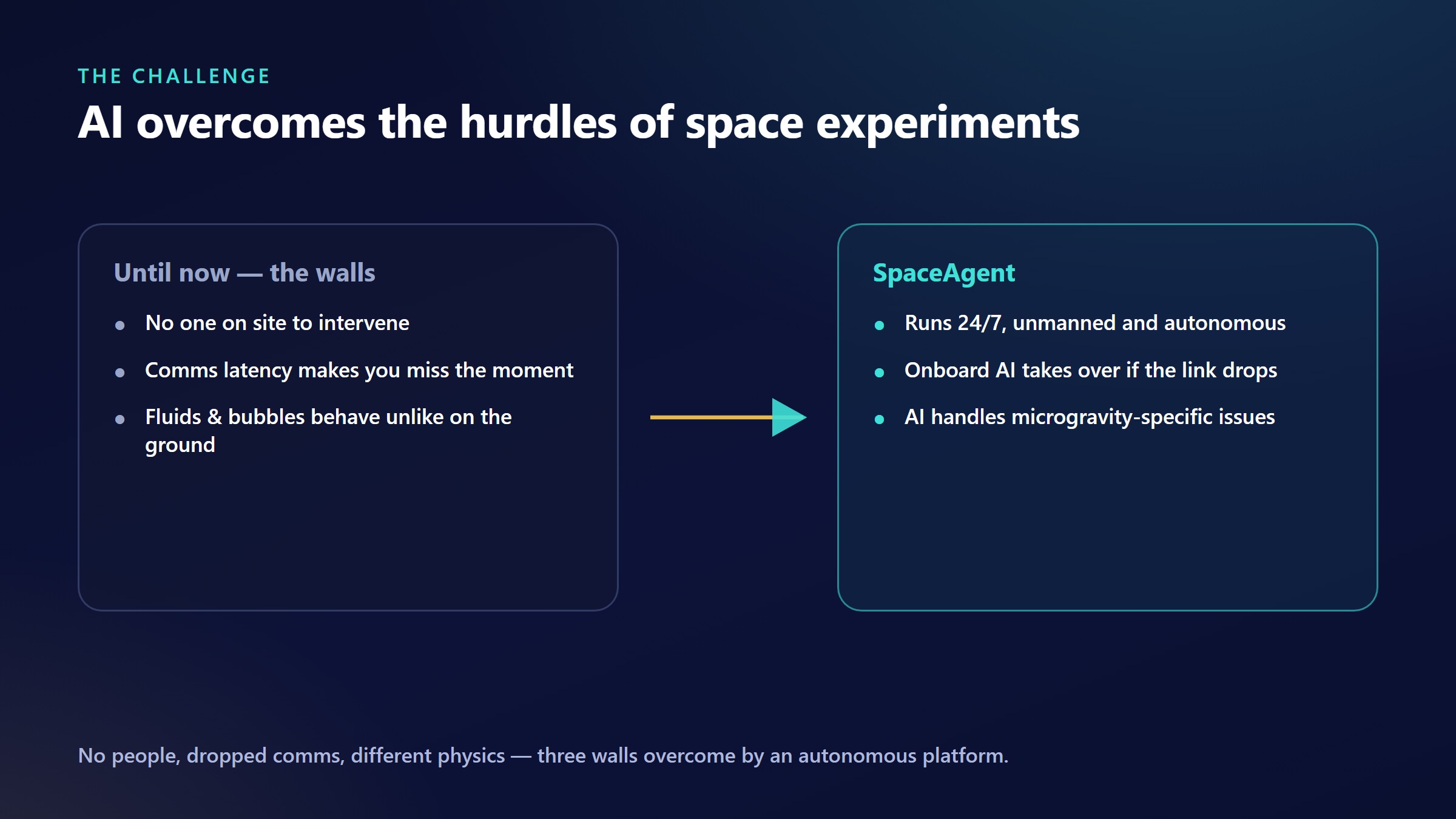
No human hands. No researcher can stand beside an instrument in orbit. The judgments and adjustments people have always made by hand — swapping samples, noticing an anomaly and intervening — must be handled by someone, or something, else.
Communication is not always available. Links between the ground and orbit have latency and drop out for stretches of time. A “send every command from the ground” approach risks missing the moment while waiting.
The physics is different. In microgravity, liquids and bubbles behave unlike on the ground, so ground-built procedures do not always transfer directly.
These three walls — no people, dropped links, different physics — have been the fundamental barrier to using space as a serious venue for experiments.
The same wall stands on the ground
The challenge is not unique to space. In materials and drug-discovery research, vast numbers of trials are run by varying compositions and conditions. Machine learning can now narrow down promising candidates computationally, but the step of actually making, measuring and confirming them still depends on manual operation and on control software that differs from instrument to instrument. The power to “propose candidates by computation” is advancing fast, while the automation of “confirming them in the real world” lags behind. SpaceAgent is designed to clear both — the difficulty of space and the automation gap on the ground — with one common foundation.
What is new: an “operating system for experiments”
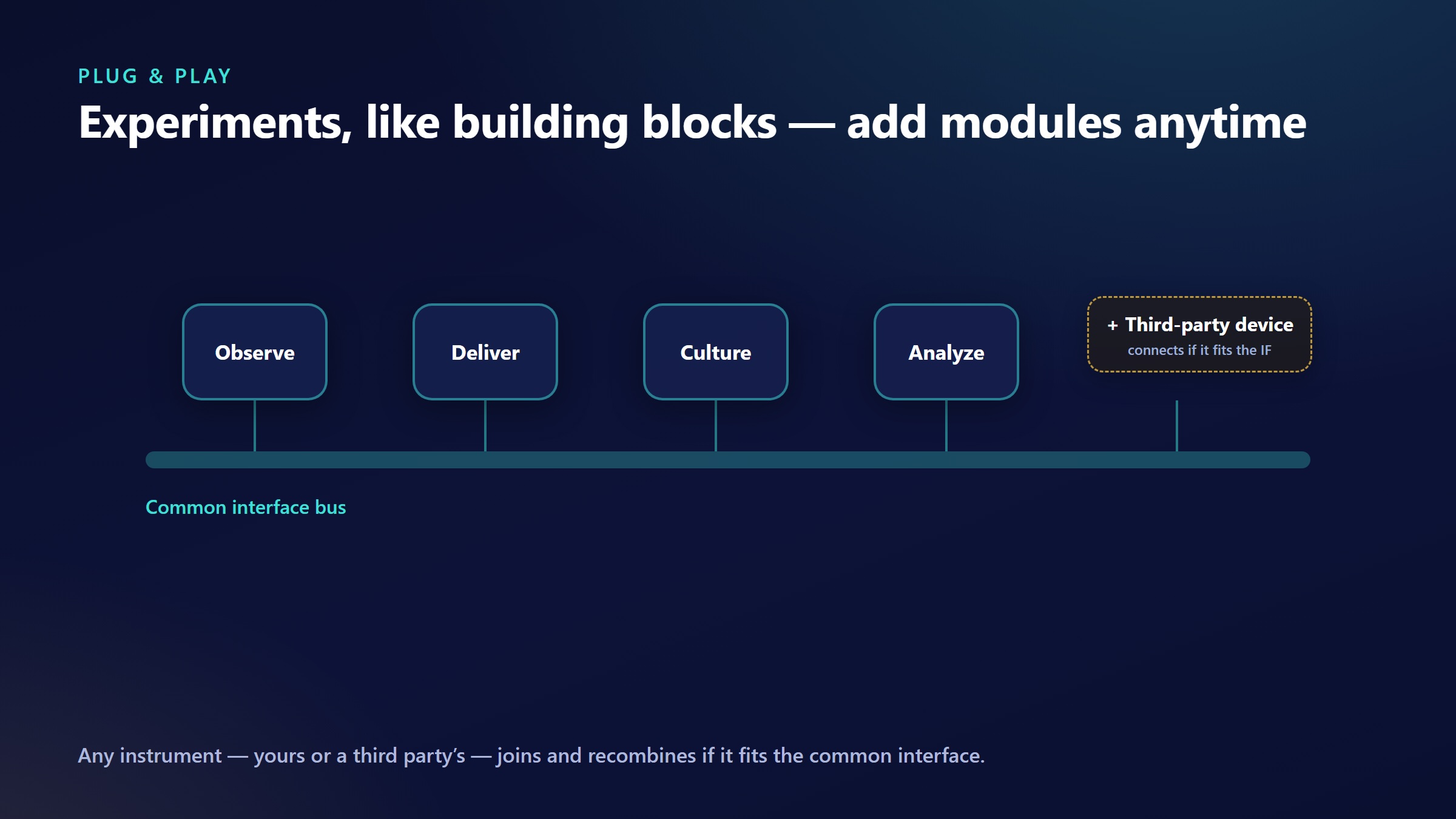
At the core of SpaceAgent is the idea that a single AI binds together different kinds of experiment instruments and controls them across a common interface. Observation, delivery, culture, crystallization, environmental control, dispensing, analysis — instruments that have run separately are connected through a common port, and the AI reads the situation and issues the operations each instrument needs. New kinds of instruments can be added later by matching the same port — treating the laboratory like reconfigurable building blocks.
For space, the platform is designed to:
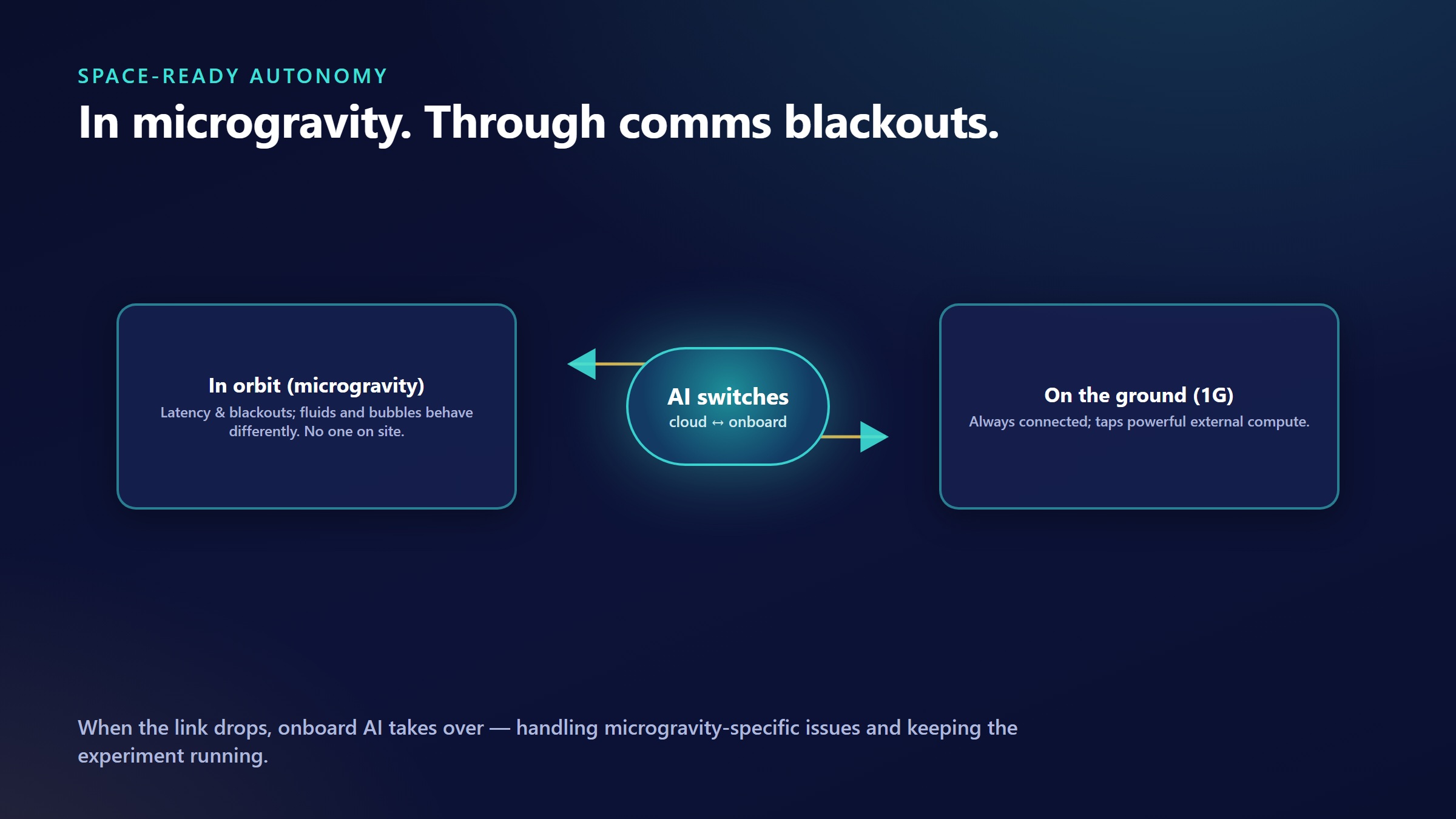
Switch where it “thinks.” While communication is stable it uses ground-side computing; when the link drops it uses the device’s onboard intelligence, switching the seat of judgment automatically so experiments do not stop.
Handle microgravity-specific trouble. The AI interprets and attempts recovery from issues unique to space, such as bubble intrusion and altered fluid behavior.
Close the loop, hypothesis to hypothesis. It runs the research cycle — form a hypothesis, design an experiment, operate instruments, observe and measure, analyze, record, and form the next hypothesis — without human hands.
The researcher’s role shifts from issuing each operation one at a time to setting the question and the direction. SS-HD positions this as an operating system for experiments — not tied to any particular instrument or maker.
Two inventions
The filing comprises two complementary inventions:
A general-purpose invention — the core “experiment OS” that orchestrates diverse instruments across experiment types, a foundation applicable from space biology to materials and drug discovery (Japanese Patent Application No. 2026-097380).
A cell-experiment-specialized invention — focused on cell-based experiments, in which the AI judges, as one, the operations of delivering bioactive substances and of adjusting temperature and environment (Japanese Patent Application No. 2026-097387).
Securing both the general foundation and the first concrete application gives the platform breadth as a base and certainty as a practical system.
A four-company collaboration
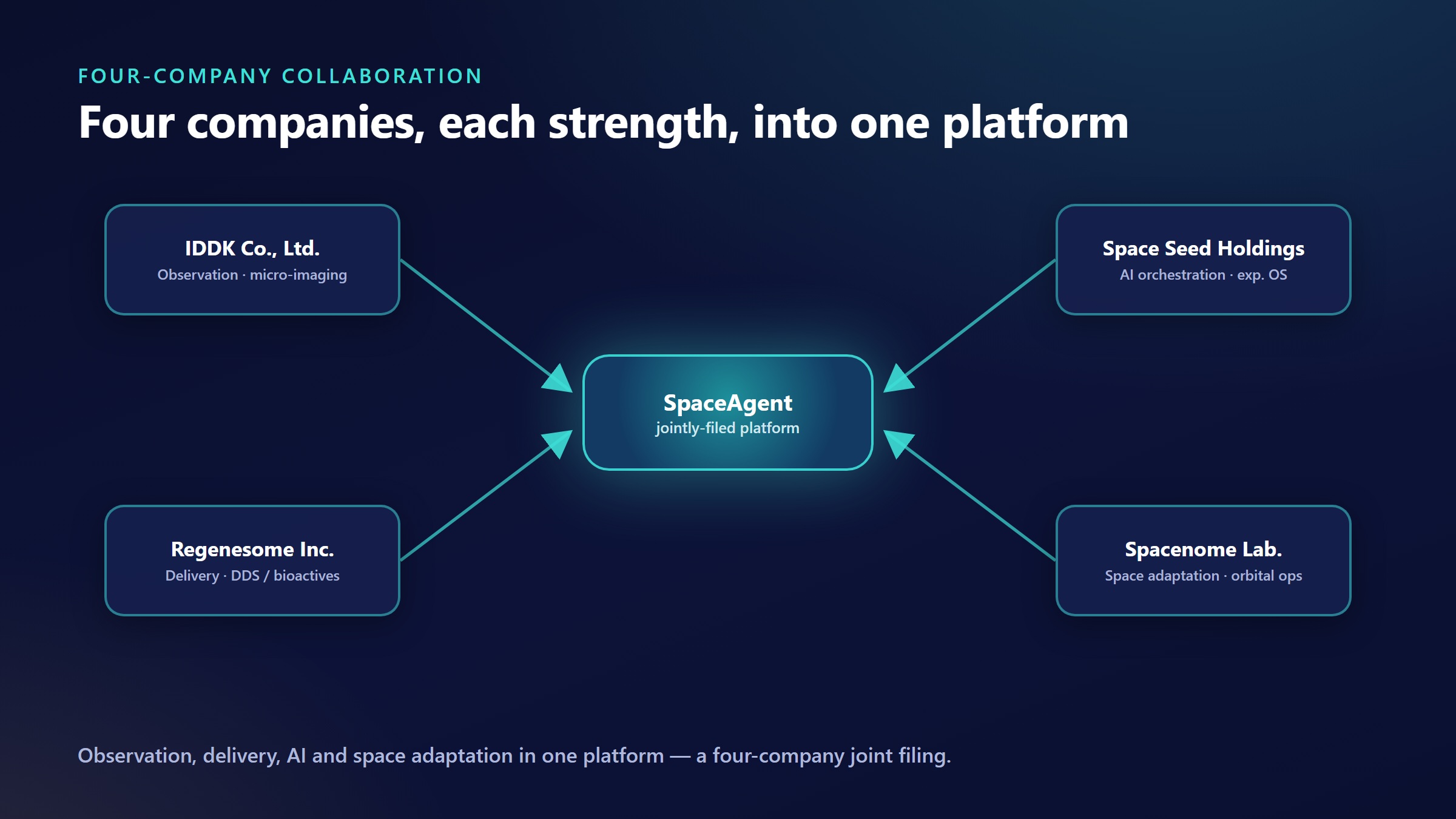
SpaceAgent is a joint filing by four companies, each bringing its own strength into one platform, and SS-HD embraces its partners as essential collaborators:
IDDK Co., Ltd. — observation, via its micro-imaging device technology.
Regenesome Inc. — delivery, the controlled release of bioactive substances.
Space Seed Holdings Inc. — the AI orchestration core, the experiment OS.
Spacenome Lab., Inc. — adaptation to the space environment and on-orbit operations.
How research itself changes
Looking toward the future, SpaceAgent points to a change in the very shape of research. Unmanned autonomous laboratories sit in orbit, linked to ground sites by a single AI and operated together as a fleet; a researcher, from their own lab, sends a question — “I want to test this hypothesis” — and experiment facilities distributed across space and the ground run on their own, and results come back. Experiments do not stop for 24 hours, and proceed even where no one can be present.
“What we are building is not a tool that automates a single instrument — it is a foundation that changes how research itself is done,” said Kengo Suzuki. “Until now, science has assumed a person is present, moving their hands and judging with their eyes. But the places people cannot reach, like space, are exactly where the phenomena we most want to observe are hidden. So we are building a system in which experiments think and proceed on their own — even with no one present, even when the link drops — forged under the harshest condition there is.
“Our slogan is ‘supporting research, reaching for space,’ and our mission is to make science fiction nonfiction. An AI running experiments by itself in orbit — a scene that would have been science fiction not long ago — we mean to turn into ordinary research infrastructure. And by 2040, we aim to assemble, one foundation at a time, the technologies humanity needs to live in space. These filings are a firm first step on that long road.”
What’s next
Building on these applications, SS-HD and its partners plan to:
Pursue international protection, with PCT international applications under consideration.
Expand the application domains, from space biology (cell culture, drug discovery) through to materials and analytical experiments.
Grow research collaborations, proposing the autonomous-experiment platform for the research themes of national institutions and large enterprises.
Move from ground to orbit, advancing step by step from ground-based simulation to on-orbit demonstration using compact experiment modules.
Connecting AI’s “discovery of candidates” through to “confirming them in the real world,” across space and the ground — SS-HD will advance this foundation in continual dialogue with the research front line.
About Space Seed Holdings Inc.
Space Seed Holdings Inc. (founded January 2024; Minato-ku, Tokyo) is a deep-tech venture builder under the slogan “supporting research, reaching for space” and the mission “making science fiction nonfiction.” Its businesses include the space-utilization research business SPACE LAB., and deep-tech ventures in the space × fermentation and space × medicine domains. CEO Kengo Suzuki is a co-founder of euglena Co., Ltd. and Team Director of the Algae Resource Upcycling Research Team at RIKEN TRIP-BZP. Official site: https://ss-hd.co.jp/